
Wet Press vs. Dry Press Molded Pulp: The Ultimate Engineering Guide for B2B Packaging Buyers
As global plastic bans tighten and the demand for sustainable packaging skyrockets, molded pulp (molded fiber) has emerged as the premier eco-friendly alternative. However, when sourcing custom pulp packaging from a manufacturer, B2B buyers and product designers frequently encounter a critical technical choice: Should you choose Wet Press or Dry Press molded pulp?
Contact Inquiry Email: vip@bestpluspulp.com
While both technologies utilize recycled or virgin plant fibers (such as sugarcane bagasse, bamboo, or wood pulp), their manufacturing processes, physical properties, and cost structures are vastly different.
This comprehensive engineering guide breaks down the technical and commercial differences between Wet Press and Dry Press molded pulp to help you make the most cost-effective and high-performance choice for your product.
Underlying Manufacturing Processes
What is Dry Press Molded Pulp? (Traditional / Thick-Wall)
Often referred to as traditional or transfer-molded pulp, the dry press process involves forming the fiber product in a mold and then transferring it to an oven to dry.
The Process: Fibers are vacuum-formed onto a screen mold. The wet product is then transferred to a drying oven conveyor. Because it dries without high mechanical pressure, the water evaporates naturally, leaving the fibers relatively loose.
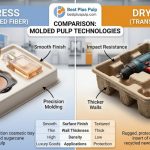
Result: A thick, lightweight, and highly shock-absorbent cushioning material. One side is relatively smooth (the mold side), while the other side remains rough and textured.
Contact Inquiry Email: vip@bestpluspulp.com
What is Wet Press Molded Pulp? (Thermoformed / Thin-Wall)
Wet press technology, also known as thermoformed fiber packaging, represents the premium tier of modern molded pulp manufacturing.
The Process: After the fiber slurry is vacuum-formed on the mold, the product is not sent to an oven. Instead, it is immediately transferred to a set of matched, heated metal molds that press and dry the product simultaneously under immense pressure and high temperature.
Result: The extreme heat and pressure compress the fibers into a highly dense, rigid, and incredibly smooth structure. Both sides of the product are perfectly smooth, mimicking the precision of plastic injection molding.
Performance & Aesthetics: Which Looks and Protects Better?
Structural Integrity & Cushioning
Dry Press wins on Shock Absorption: Because Dry Press pulp is thicker and contains microscopic air pockets within the uncompressed fibers, it acts like a natural sponge. It is exceptionally good at absorbing heavy impacts during transit.
Wet Press wins on Rigidity: Wet Press pulp behaves like rigid plastic. It does not compress easily, making it perfect for holding heavy, high-density items structural securely without bending.
Aesthetic Appeal & Customer Unboxing Experience
Dry Press (Industrial Vibe): It looks inherently industrial and rustic. While it screams “eco-friendly,” it lacks a premium feel. It can also shed micro-fibers (dusting), which might cling to static-sensitive products.
Wet Press (Premium Consumer Vibe): It offers a luxury unboxing experience. The surface can be dyed into vivid colors (white, black, custom Pantone) and can hold complex geometries, sharp corners, and elegant geometric lines. It has zero dusting, making it cleanroom-compatible.
Contact Inquiry Email: vip@bestpluspulp.com
Industrial Applications: Making the Right Choice
To simplify your procurement decision, our engineering team has mapped out the ideal application for each technology:
Ideal Applications for Dry Press Pulp:
Heavy Industrial Parts: Buffers for automotive components, heavy pumps, and machinery.
Agricultural Logistics: Standard 30-count commercial egg trays, fruit trays, and wine bottle shippers where structural cosmetics do not matter.
Large Appliances: Corner protectors for refrigerators, washing machines, and televisions.
Ideal Applications for Wet Press Pulp:
Consumer Electronics: Inner trays for smartphones, wireless earbuds, smartwatches, and laptops.
Cosmetics & Luxury Goods: High-end perfume inserts, skincare gift boxes, and jewelry packaging.
Food Service & Medical: Plates, bowls, cup lids, and medical trays that require hygienic, FDA-compliant, non-dusting smooth surfaces.
Premium Retail Retail Egg Cartons: High-end 6-cell or 12-cell organic egg boxes that require crisp branding and graphics on supermarket shelves.
Conclusion: Partner with Best Plus Pulp for Your Custom Solution
Choosing between Wet Press and Dry Press isn’t about finding which technology is objectively “better”—it is about aligning your packaging choice with your product’s value, shipping vulnerabilities, and brand identity.
Contact Inquiry Email: vip@bestpluspulp.com
At Best Plus Pulp, we operate state-of-the-art manufacturing facilities capable of producing both heavy-duty Dry Press industrial buffers and high-precision, FDA-compliant Wet Press thermoformed packaging. Whether you need to secure industrial machinery components or elevate your retail brand on the shelf, our engineers are here to guide you from 3D CAD design to mass production.
Ready to transition your packaging to sustainable molded fiber? [Contact our engineering team today] for a free design consultation, tooling quotation, or to request a sample kit of our Wet Press and Dry Press materials.
Molded fiber packaging is very sustainable, 100% biodegradable and ideal for all your corporate branding needs.
Best Plus Pulp Company can make best pulp packages for your requirement of egg boxes/ egg cartons.
From Best Plus Pulp www.bestpluspulp.com We manufacture and customize the Pulp Paper Tray and Pulp Egg Cartons, Egg Tray, Egg Cartons,, Egg Packs, Pulp Basket, Wine Pulp Tray, Shoe Pulp Tray, and other customized Pulp packaging products.
Email: vip@bestpluspulp.com
Web: www.bestpluspulp.com
 Previous Post
 Next Post